Equations II

| © 2004 Rasmus ehf |
Equations II |
|
Lesson 3.
Second degree equations
Example 1
 |
|
|
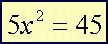
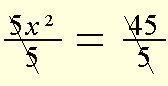
First we simplify and divide by the coefficient of the variable (5) on both sides of the equation |
 |
Finally we get this result after simplifying |
| If an equation contains a variable squared (to the power of 2 ) | ||||
| such as |  |
or |  |
after it has been simplified, it is called a second degree equation. |
We know that the square root of a number is one of the two equal factors of that number (the square root of x is the inverse of x2 ).
| We see that: |  |
and |  |
Both (-3)2 and 32 = 9
Example 2
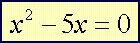 To solve
equations like this, begin by factorising.
To solve
equations like this, begin by factorising.
x(x - 5) = 0 If either of the factors is 0, the equation is true.
0(x - 5) = 0 or x(0) = 0

The result is x = 0 .
or 
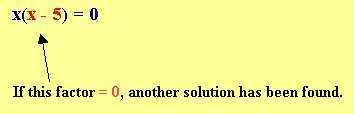
The result is
x - 5 = 0 or
x = +5 .
or 
| When equations have more than one possible solution, | ||||
| the solutions are labelled |  |
and |  |
to avoid confusion. |
Try Quiz 3 on Equations 2.
Remember to use the checklist to keep track of your work.