© 2008 Rasmus ehf and Jóhann Ísak Pétursson
Sequences and Series

© 2008 Rasmus ehf and Jóhann Ísak Pétursson |
Sequences and Series |
|
Look at the expression 1 + 2 + 3 + 4 + 5 + 6 + 7 + 8 + 9 + 10. It contains ten terms of an arithmetic sequence (AP) with the difference d = 1 added together. An expression like this containing a sequence of numbers from an AP added together is called an arithmetic series.
If a1, a2, a3, a4, . . . . . . , an is an arithmetic sequence then a1 + a2 + a3 + a4 + ∙ ∙ ∙ ∙ ∙ ∙ + an is an arithmetic series
Now we will try to find a formula for a sum of n terms like this. The difference between each term is d so we can write the sum of n terms as Sn where
Sn= a1 + (a1 + d) + (a1 + 2d) + (a1 + 3d) + ∙ ∙ ∙ ∙ ∙ ∙ + (a1 + (n−1)d)
If we write the sum backwards we get
Sn= an + (an − d) + (an − 2d) + (an − 3d) + ∙ ∙ ∙ ∙ ∙ ∙ + (an − (n−1)d)
Adding these two expression together gives us

= n∙a1 + n∙an
= n∙( a1 + an)
Dividing by 2 gives us the rule for the sum of an Arithmetic series with n terms:
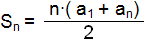 |
This is easy to remember and understand because we are simply finding the average of the first and last term and then multiplying by the number of terms.
Find the sum of the whole positive numbers from 1 up to 100.
The average of
the first and last terms is
101/2 = 50.5.
Multiplying this by 100, the number of terms, gives us 5050.
Using the above formula gives, of course, the same answer:
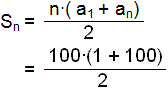
= 50∙101 = 5050
Find the sum of all two digit whole positive numbers.
The first number a1 = 10 and the last is 99. We need to know the number of this term. It's safest to use the formula for an AP to find this out.
an = a1 + (n – 1)∙d
99 = 10 + (n − 1)∙1
99 = 9 + n
n = 99 – 9 = 90
So there are 90 numbers and we can find the sum using either of the methods in example 1.
The average of the first and last numbers is (10 + 99)/2 = 54.5
Multiplying this by the number of terms gives us 54.5∙90 = 4905
Find the sum of the arithmetic series 2 + 7 + 12 + 17 + 22 + 27 + 32.
There are 7 terms in this series and the difference between each term is 5.
The average of the first and last term is (2 + 32)/2 = 17.
Multiplying by the number of terms gives the answer 17∙7 = 119
This example is easily solved using EXCEL.
| 1) | 2) | 3) | 4) |
|
|
|
|
|
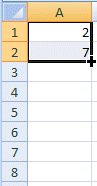
1) Begin by writing
the first two terms 2 and 7 in cells A1 and A2. This establishes a pattern which
we can copy down.
Do this by blocking the two cells together, moving the mouse point to the bottom
right corner of the block where a black cross will appear.
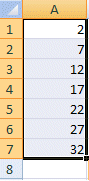
2) Now holding the left mouse button in, drag the cross down to cell A7. The sequence of numbers should then appear correctly.
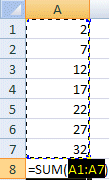
3) Next click the mouse button in cell A8 and press ∑ (read sigma) on the toolbar. The formula =SUM(A1:A7) appears in the cell telling us that the numbers in cells A1 to A7 will be added together..
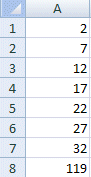
4) Click the mouse or press ENTER to accept this formula and the answer 119 will appear in cell A8.
The symbol ∑ is often used to denote sums of numbers. When this is done a counter is used. The starting value of the counter is shown at the lower end of the symbol and the end value at the top of the symbol..
The following is an example using the letter n as the counter. n starts at 1 and ends at 7. The counter only uses whole positive numbers, increasing by one at each step.

= 1 + 4 + 9 + 16 + 25 + 36 + 49 = 140
If we want to use the sigma symbol to show the sum
2 + 7 + 12 + 17 + 22 + 27 + 32
we have to begin by finding a formula for a general term. The terms form an AP so we can use the formula an = a1 + (n – 1)∙d. There are 7 terms and the difference d = 5.
an = 2 + (n – 1)∙5 = 2 + 5n – 5 = 5n – 3
The sum can be written as follows:

+ (5∙5 – 3) + (5∙6 – 3) + (5∙7 – 3)
= 2 + 7 + 12 + 17 + 22 + 27 + 32 = 119

The counter goes from 1 up to 8 so we get the following sum:

This is an arithmetic sequence. The average of the first and last term is (9 + 16)/2 = 12.5
There are 8 terms so multiplying by the number of terms gives us.

Find the sum of all three digit positive numbers divisible by 8 and write the sequence using the sigma notation.
The smallest number is 104 , the biggest is 992 and the difference d = 8. We use this to find the number of terms.
The terms form an AP so we use the rule for the n th term of an AP to find a formula.
an = a1 + (n – 1)∙d
= 104 + (n – 1)∙8 = 104 + 8n – 8 = 8n + 96
Now we can find the number of terms:.
an = a1 + (n – 1)∙d
992 = 104 + (n – 1)∙8 = 104 + 8n – 8 = 96 + 8n
992 – 96 = 8n = 896
n = 896/8 = 112
Writing this using the sigma notation gives

= 112∙(104 + 992)/2 = 61,376
Find the minimum number of different three digit numbers divisible by 8 that we need to make a sum greater than 10,000.
Starting with the biggest possible three digit number and working backwards we get Sn = 992 + 984 + 976 + ∙ ∙ ∙ ∙ ∙ ∙
The difference d = −8, a1 = 992 og Sn = 10,000.
Using the rule for the sum of the arithmetic series gives
Sn = n∙(992 + an)/2 = 10,000
an = 992 + (n – 1)∙(−8) = 1000 – 8n.
Putting this value for an into the formula for the sum and solving for n gives
n∙(992 + 1000 – 8n)/2 = 10,000
n∙(992 + 1000 – 8n) = 20,000
n∙(1992 – 8n) = 20,000
This gives a quadratic equation to solve
1992n – 8n2 = 20,000
Dividing through by –8 and rearranging
n2 – 249n + 2500 = 0
Now we can solve this using the quadratic equation formula
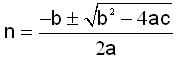
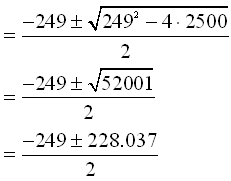
Giving the solutions 10.5 and 238.5.
The higher value obviously doesn´t work so the answer is 11. Can you work out where the bigger number comes from? The answer 11 makes sense as we are adding together numbers that are all slightly less than 1000 and we need slightly more than 10 numbers to make 10000.
Practise these methods then try
Quiz 3 on Sequences and Series
Remember to use the checklist to keep track of your work.